- skip - about - login - register
The horizontal line represents the person’s life.1635 - born1671 - “Jus imaginis apud Anglos, or the Law of England relating to the Nobility and Gentry”1673 - “Jus Sigilli; or the law of England touching the four principal Seals, the great seal, privy seal, exchequer seal, and the signet; also those grand officers to whose custody those seals are committed”; “Speculum Juris Anglicani; or a view of the Laws of England, as they are divided into statutes, common-law, and customs”1673 - “Jus Sigilli; or the law of England touching the four principal Seals, the great seal, privy seal, exchequer seal, and the signet; also those grand officers to whose custody those seals are committed”; “Speculum Juris Anglicani; or a view of the Laws of England, as they are divided into statutes, common-law, and customs”1675 - “Jus criminis, or an abridgment of the laws of treason, murther, conspiracies, poisonings, &c”1076 - “Camera Regis, or a short view of Lon^ don, viz. antiquity, &c, officers, courts, customs, franchises”1679 - “Decus et tutamen; or a prospect of the laws of England, framed for the safeguard of the king’s majesty”1697 - “Ars transferendi; of sure guide to the conveyancer”1700 - “Non compos mentis; or, the law relating to natural fools, mad folks, and lunatic persons”1703 - “Lex Spuriorum; or, the law relating to bastardy, collected from the common, civil, and ecclesiastical laws”1704 - “Declaration of the divers preheminences or privileges allowed by the laws and customs of England, unto the firstborn among her majesty’s subjects the temporal lords in parliament”1680 - “Jura Coronae; or, his majesty’s royal rights and prerogatives asserted against papal usurpations, and all other antimonarchical attempts and practices”1704 - died

Brydal, John

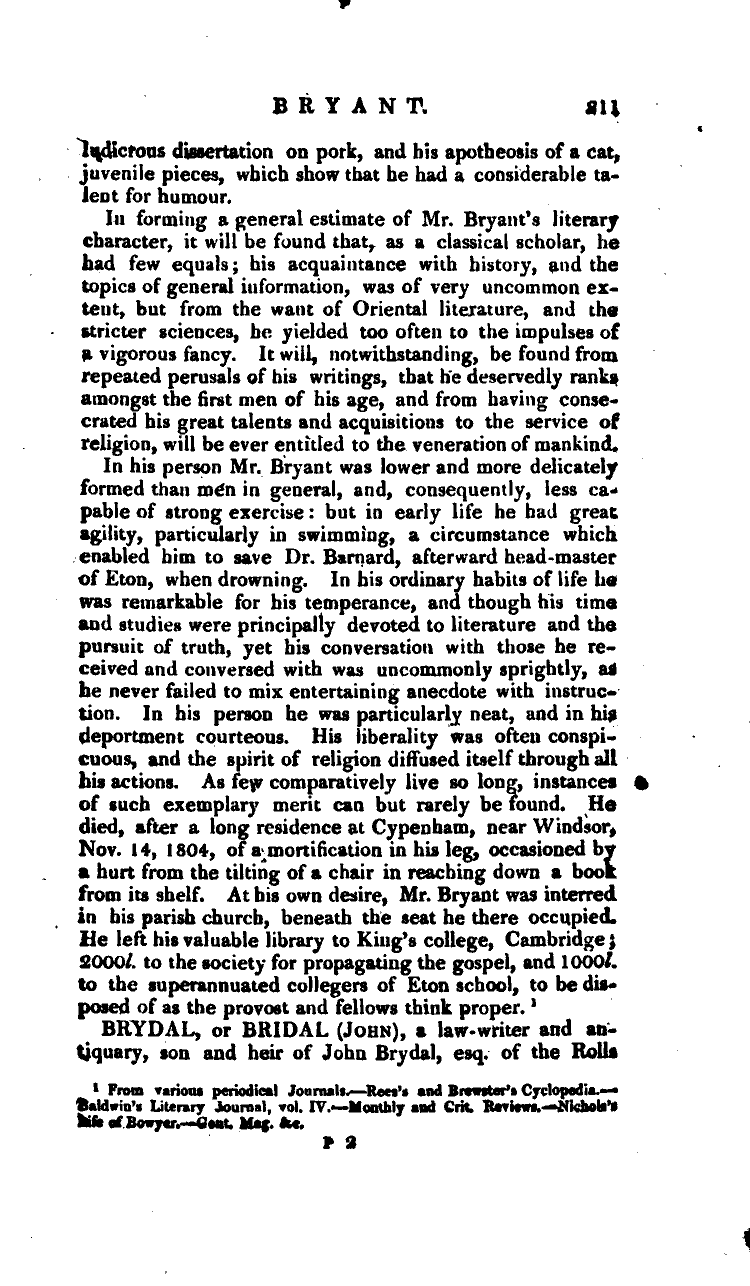
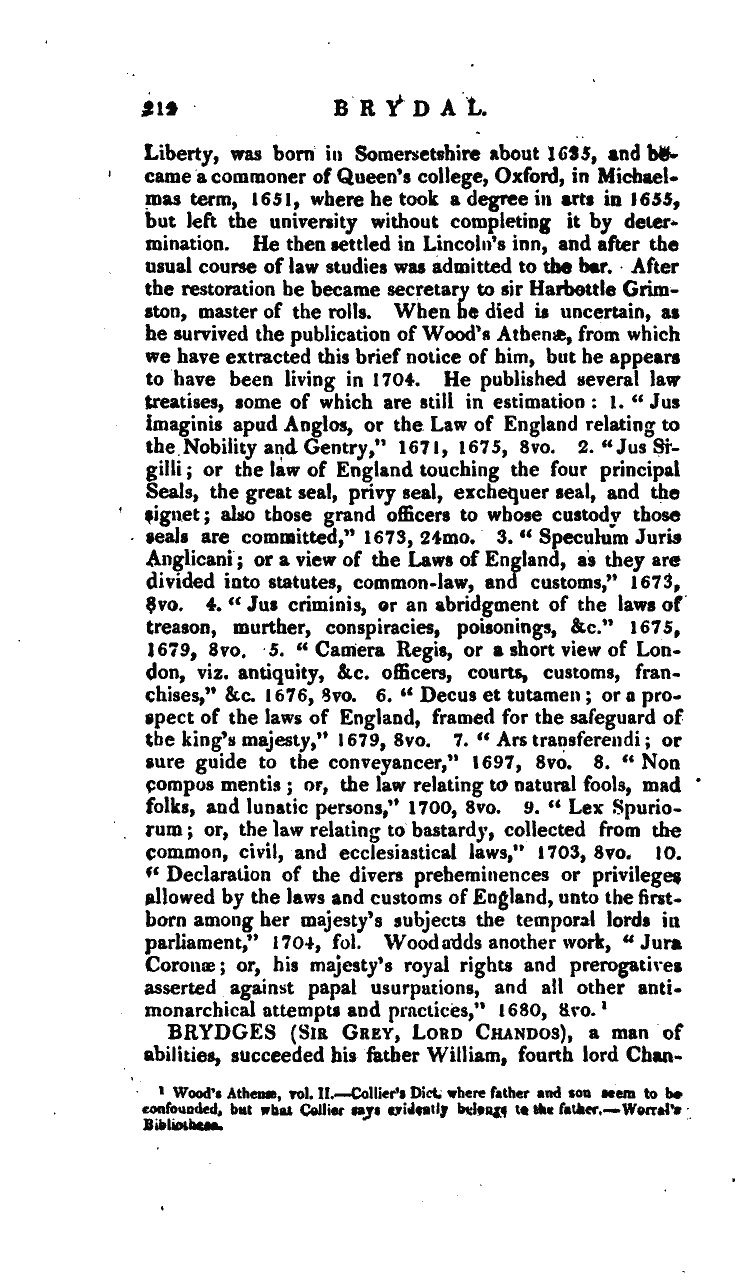
, a law-writer and antiquary, son and heir of John Bry<lal, esq. of the Rolls | Liberty, was born in Somersetshire about 1635, and became a commoner of Queen’s college, Oxford, in Michaelmas term, 1651, where he took a degree in arts in -1655, but left the university without completing it by determination. He then settled in Lincoln’s inn, and after the usual course of law studies was admitted to the bar. After the restoration he became secretary to sir Harbottle Grirnston, master of the rolls. When he died is uncertain, as he survived the publication of Wood’s Athenae, from which we have extracted this brief notice of him, but he appears to have been living in 1704. He published several law treatises, some of which are still in estimation: 1. “Jus imaginis apud Anglos, or the Law of England relating to the Nobility and Gentry,1671, 1675, 8vo. 2. “Jus Sigilli; or the law of England touching the four principal Seals, the great seal, privy seal, exchequer seal, and the signet; also those grand officers to whose custody those seals are committed,1673, 24mo. 3. “Speculum Juris Anglicani; or a view of the Laws of England, as they are divided into statutes, common-law, and customs,1673, 8vo. 4. “Jus criminis, or an abridgment of the laws of treason, murther, conspiracies, poisonings, &c.1675, 1679, 8vo. 5. “Camera Regis, or a short view of Lon^ don, viz. antiquity, &c, officers, courts, customs, franchises,” &c. 1076, 8vo. 6. “Decus et tutamen; or a prospect of the laws of England, framed for the safeguard of the king’s majesty,1679, 8vo. 7. “Ars transferendi; of sure guide to the conveyancer,1697, 8vo. 8. “Non compos mentis; or, the law relating to natural fools, mad folks, and lunatic persons,1700, 8vo. 9. “Lex Spuriorum; or, the law relating to bastardy, collected from the common, civil, and ecclesiastical laws,1703, 8vo. 10. “Declaration of the divers preheminences or privileges allowed by the laws and customs of England, unto the firstborn among her majesty’s subjects the temporal lords in parliament,1704, fol. Wood adds another work, “Jura Coronae; or, his majesty’s royal rights and prerogatives asserted against papal usurpations, and all other antimonarchical attempts and practices,1680, 8vo. 1

1

Wood’s Athena, vol. II.—Collier’s Dict. where father and son seem to be confounded, but what Collier says evidently belongs to the father.—Worral’s Bibliotheca

previous entry · index · next entry

ABCDEFGHIJKLMNOPQRSTUVWXYZ

Entry taken from General Biographical Dictionary, by Alexander Chalmers, 1812–1817.

This text has been generated using commercial OCR software, and there are still many problems; it is slowly getting better over time. The text was scanned and OCRd several times, and a majority version of each line of text was chosen. Please don't reuse the content (e.g. do not post to wikipedia) without asking liam at holoweb dot net first (mention the colour of your socks in the mail), because I am still working on fixing errors. Thanks!

previous entry · index · next entry

Bruys, Francis (1708–?)
Bruys, Peter De
Bruzen
Bryan, Sir Francis (?–1550)
Bryant, Jacob (1715–?)
Brydal, John (16351704)
Brydges, Sir Grey, Lord Chandos (?–1621)
Brye, Theodore De (1528–?)
Bryennius, Nicephorus
Bryennius, Manuel
Buat-Nancay, Louis Gabriel Du (17521787)
Find a used copy on abebooks
Buy volume 7...
[the book]