Musschenbroeck, Peter De
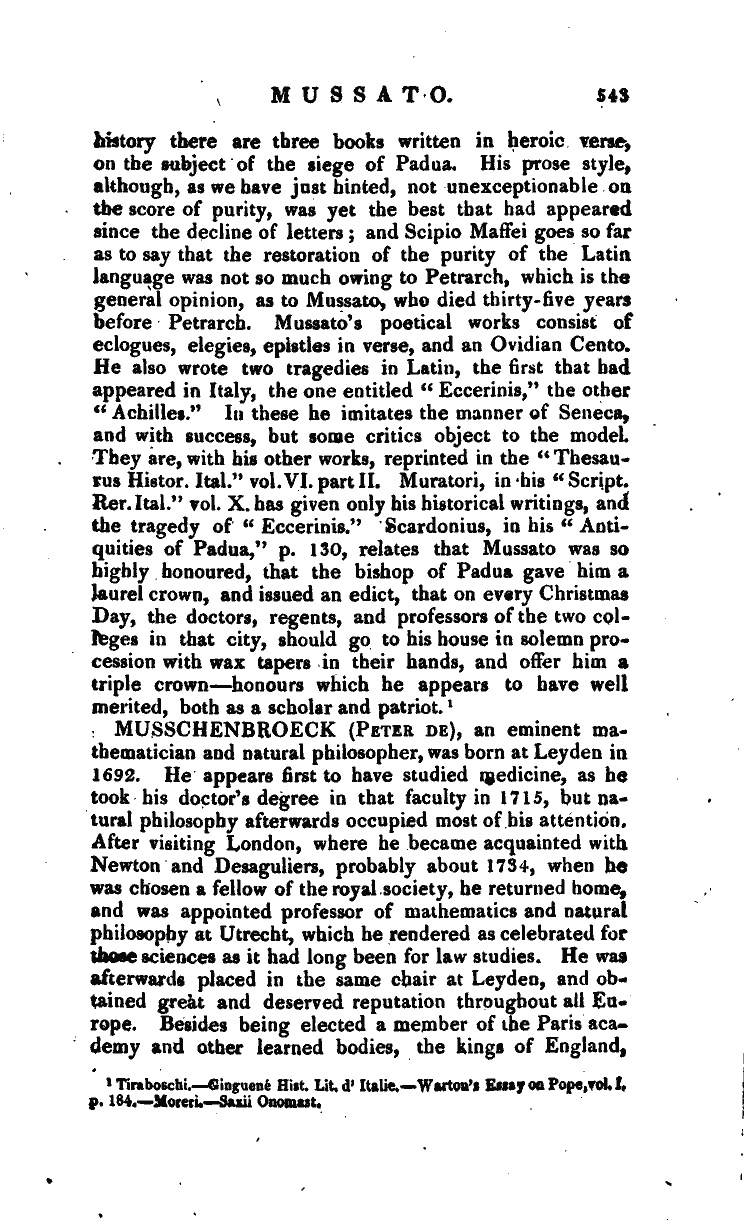
, an eminent mathematician and natural philosopher, was born at Leyden in 1692. He appears first to have studied medicine, as he took his doctor’s degree in that faculty in 1715, but natural philosophy afterwards occupied most of his attention. After visiting London, where he became acquainted with Newton and Desaguliers, probably about 1734, when he was chosen a fellow of the royal society, he returned home, and was appointed professor of mathematics and natural philosophy at Utrecht, which he rendered as celebrated for those sciences as it had long been for law studies. He was afterwards placed in the same chair at Leyden, and obtained great and deserved reputation throughout all Europe. Besides being elected a member of the Paris academy and other learned bodies, the kings of England, | Prussia, and Denmark, made him tempting offers to reside in their dominions; but he preferred his native place, where he died in 1761. He published several works in Latin, all of them demonstrating his great penetration and accuracy: 1. “Disputatio de Aeris praesentia in humoribus animalibus,” Leyd. 1715, 4to. 2. “Epitome Elementorum Pbysico-mathematicorum,” ib. 1729, 4to. 3. “Physicx, experimentales, et geometries Dissertationes: ut et Ephemerides meteorologicae Utrajectenses,” ibid. 1729, 4to. 4. “Tentamina Experinientorurn naturalium, in academia del Cimento, ex Ital. in Lat. conversa,” ibid. 1731, 4to. 5. “Elementa Physicsc,” 1734, 8vo, translated into English by Colson, 1744, 2 vols. 8vo. His “Introduction to Natural Philosophy,” which he began to print in 1760, was completed and published at Leyden in 1762 by M. Lulofs, after the death of the author. There is a French translation, of Paris, 1769, 3 vols. 4to. Musschenbroeck is also the author of several papers, chiefly on meteorology, printed in the volumes of the “Memoirs of the Academy of Sciences” for 1734, 1735, 1736, 1753, 1756, and 1760. 1


![[the book]](../../g/51t48Ik2JTL._SL160_.jpg)